
Eighteen Percent
Last Thursday, on our community call, a lawyer at a large US firm told us his firm runs on Harvey, and for the past year he’s been struggling with trying to figure out how can he do in Harvey what he can easily do in Claude. He reckons it’s about 18%.
Then on Saturday, a personal injury lawyer told me he puts 1,000 pages of medical records into Claude, asks for every earlier complaint about the neck or the back, and has the page numbers a few minutes later.
Two completely unrelated stories but I chose to open this week’s edition with them because this is exactly what I’m hearing from law firms across the board:
-
Firms finding the limits of their specialized legal AI tools.
-
Firms doing the work that specialized legal AI platforms were built for, on general platforms instead.
The 12-Month Cycle
Up until this year, firms started with ChatGPT or Claude, Gemini or Copilot, and a lot of them ended up buying a specialized legal AI tool. Someone starts using a general AI tool at home, brings it to work, and at some point hits a wall: it doesn’t know the firm’s documents, it can’t handle a 400-page bundle, and nobody has put in writing what happens to the client data. So the firm buys EvenUp, Supio, Eve, because they hired lawyers, put the data terms in writing, and gave you something that works on day one. Kind of.
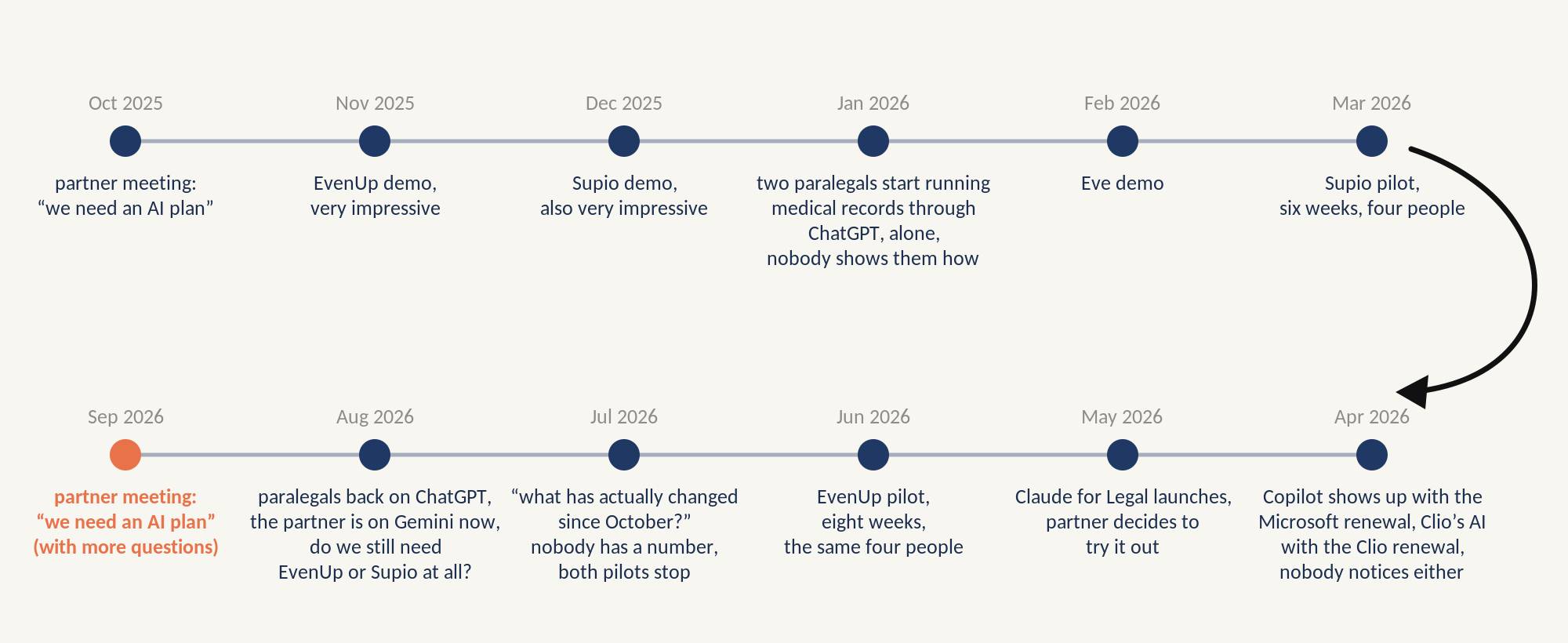
And after hundreds of conversations with vendors and law firms, here’s my attempt at summarizing the cycle law firms went through in the past 12 months:
In October the partners agreed the firm needs an AI plan. In November an EvenUp demo, very impressive, and in December a Supio demo, also very impressive. In January two paralegals started running medical records through ChatGPT on their own and nobody showed them how. In February an Eve demo. In March a Supio pilot, six weeks, four people. In April Copilot showed up with the Microsoft renewal and Clio’s AI with the Clio renewal, and nobody noticed either. In May Claude for Legal launched and one of the partners decided to try it out. In June an EvenUp pilot, eight weeks, the same four people. In July somebody asked what had actually changed at the firm since October, nobody had a number, and both pilots stopped. In August the paralegals were back on ChatGPT, the partner was on Gemini, and somebody asked whether the firm still needs EvenUp or Supio at all. And this month the partners are meeting again, because the firm needs an AI plan.
Asked The Other Way
This year, for the first time, firms that already have a specialized tool are asking whether they’d be better off building the same thing on Claude, Gemini or ChatGPT. And the vendors are preparing for it. Look at what they did at ILTACON in Nashville a couple of weeks ago.
NetDocuments added Google’s Gemini to the list of AI tools that can read its documents and matter context, next to Claude, Microsoft Copilot and Perplexity, and next to Harvey and Legora. iManage announced an integration with Gemini Enterprise for Legal, which Google launched on August 25 with Cleary, Freshfields, Weil and Williams & Connolly as its first firms. LawToolBox shipped a connector with 70 tools that hands matter data from Microsoft 365 to Copilot, CoCounsel, Harvey, Legora, Claude and ChatGPT alike. So the systems that hold your documents and your matters now connect to all of them, and you pick which AI you use.
And the specialized tools are making themselves available inside the general platforms. Thomson Reuters rebuilt CoCounsel Legal on Anthropic’s Claude Agent SDK, and since August you can use CoCounsel from inside Claude. When I asked Nitesh from Midpage on the podcast what they’re investing in most, he said the connection to AI: they want people using Midpage through Claude or ChatGPT.
What Changed
A year ago there were four reasons to buy a specialized legal AI platform, and all four have changed since:
1. It knew legal work. EvenUp and Supio hired lawyers and built the workflows, the playbooks and the checklists around the AI, while ChatGPT and Claude were chatbots. Since then the general platforms added connectors to your documents and your case system, projects, skills and playbooks, and lawyers started publishing their skills for anyone to use. I wrote about each of these over the summer.
2. It came with authoritative sources. Research and citations lived inside Westlaw and Lexis, and to get them with AI you bought CoCounsel or Protégé. Since August you can use CoCounsel, with Westlaw and Practical Law behind it, from inside Claude. Midpage runs through Claude and ChatGPT. Descrybe works inside Claude and Copilot. The authority is the same, and it now connects to whichever platform you run.
3. It was safe. The specialized tools put in writing what happens to your client data, and the general platforms hadn’t. Today, on a commercial plan, Claude, ChatGPT and Gemini don’t train on your data and put in writing what happens to it. They offer the same contractual protection as the specialized vendors do.
4. It was predictable. You paid per seat and knew your bill. Since June, vendors are moving to consumption pricing: you pay for how many tokens the tool uses when running the tasks. The general platforms still come with an option for a fixed price per seat on commercial plans.
The Same Work Either Way
You might still think the specialized tool saves you the setup. It doesn’t. EvenUp doesn’t write your demand letter playbook. Supio doesn’t map how a case moves through your office. Nobody at either trains your paralegals or sits with them for the first month when the questions come. You buy the tool, and that work still lands at your firm. It’s the same work on both sides.
So the choice comes down to three things. How far the tool can go. Whether what you build leaves with you: a skill written for Claude moves to Copilot or ChatGPT, and a workflow built inside EvenUp stays inside EvenUp. And who controls the bill.
If 80% of your revenue comes from one kind of case, a specialized tool may serve you well for a while yet, because your people won’t reach its limit soon.
So this week, before you renew anything, take the task your firm does most often. Build a project and a skill for it on the general platform you already pay for, run it next to the specialized tool for two weeks, and see where it stops.

On the Team plan:
You can now share a skills and plugins with specific people or groups. Until now a skill you built was either yours or published to the whole firm. Now you open Customize, click the three dots next to the skill, choose Share, and pick who should have it. It shows up for them under “Shared with you”, off until they turn it on, and when you save a new version they get it the next time they use it. Sharing with individuals is on by default; sharing with a group is off until your admin turns it on under Organization settings > Skills > Policy. When someone leaves the firm, everything shared with them is automatically removed.
Claude can now send messages inside Microsoft Teams. The Microsoft 365 connector already read your Outlook, SharePoint and Teams. It can now send a chat message, reply in a channel or start a chat for you. Sending is off by default. To turn it on, your Microsoft admin needs to approve the new permissions, then your Claude admin goes to Organization settings > Connectors > Microsoft 365 and turns on the toggles for Teams.
From September 9, text from Claude Opus 5 carries a watermark. Fable already has it, the other models follow in the coming weeks, and it’s there in chat, Cowork, Claude Code and the API. You can’t see it, it adds no characters, it holds nothing about your firm or the user, and there’s no setting to turn it off. Anthropic added it for the EU AI Act’s transparency rules.
Legal AI in Action
🎬 Claude, MS365 and Clio: One Question, Two Systems
A PI founder told me the one number he’d cut tomorrow is how often his firm asks opposing counsel for an extension. So I open the trucking file from last video, a month in, no deadlines yet, and have Claude read the matter in Clio and my inbox together. It finds fifteen open tasks, twelve past due, a preservation letter sitting in drafts for four weeks, every attorney task on my paralegal’s desk, and a task nobody ever wrote. Then it drafts the letters and replies, fixes the tasks, and runs every morning without me.
🎙 Judgment is Subtraction
Nitesh Daryanani is counsel at Midpage, an AI legal research company in New York. Before that he spent fifteen years in litigation: seven in India, arguing up to the Supreme Court, then eight in the US at Morrison Foerster, Latham & Watkins and a twenty-lawyer boutique in San Francisco. He went in-house in April and still does most of his own work in Claude.
We talk about why a made-up citation is so easy to miss, since the legal principle it sits under is usually correct and the case looks right next to it; the twenty percent of a litigation brief that is the same every time, and what stays repeatable in the other eighty; and why his own skill files sometimes make Claude’s answers worse. He also shared his screen for part of this one and walked through how he researches a question in Claude, first on its own and then connected to a case law database, so you can see where the difference shows up.
Coming up!
🎙 Next Tuesday at 2pm CET!
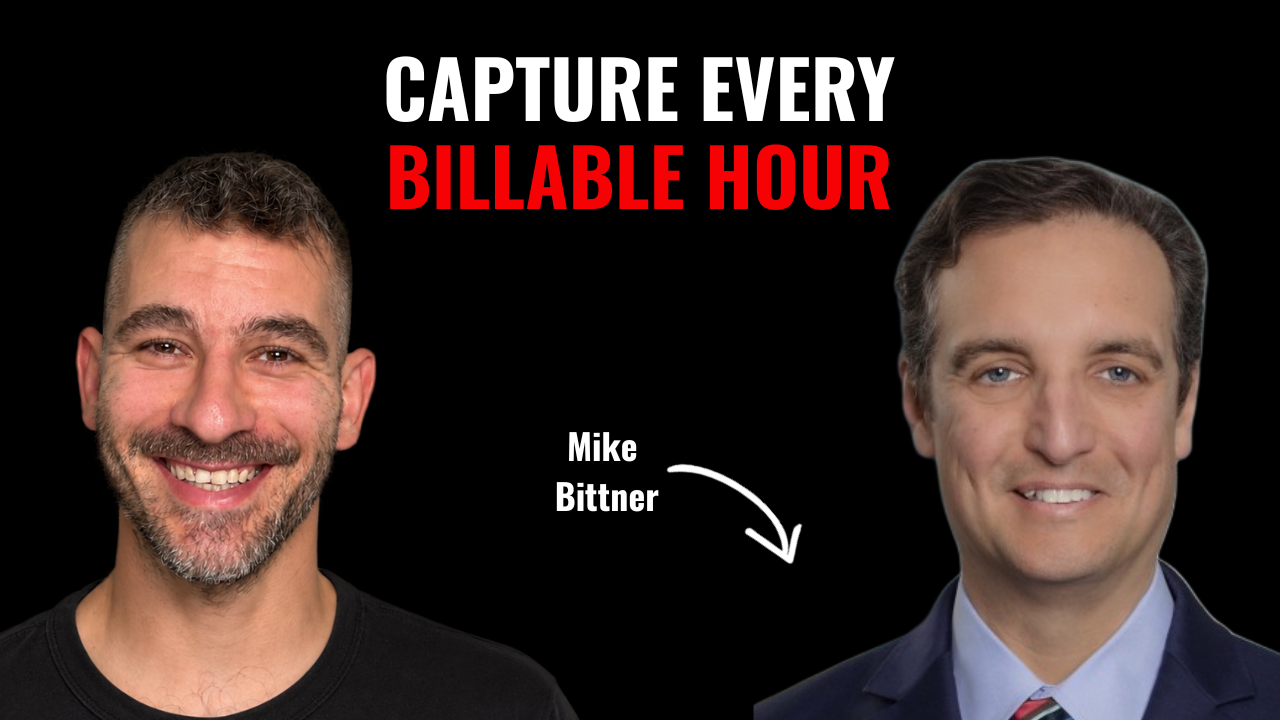
Next week’s guests on Rok’s Legal AI Conversations is Mike Bittner, a solo attorney in Jacksonville, Florida, and fractional general counsel to a software company and a cybersecurity firm. He spent seventeen years at a Jacksonville firm before going solo, and in June became Co-Vice Chair of the Florida Bar Business Law Section’s new AI Task Force.
He runs his whole practice on MB Legal OS, a system he built in Claude Cowork, and a year and a half ago he didn’t know how to open a terminal. We got into the end-session skill that drafts his time entry the moment he finishes the work; the Saturday skill that reads his week of session notes and tells him which task to automate next; and why he tells other lawyers that what he built isn’t for everybody.
Each edition of Legal AI Brief brings practical lessons from firms using AI safely.