
Since April This Year
OpenAI came out with Astra for Law last Thursday, and by Friday my inbox filled up with various flavors of essentially the following question: did we pick the wrong platform? I get why. A big launch like this from a platform that was lagging behind for the past few months, at least in legal, and a list of Am Law firms underneath - it’s easy to get distracted. And that’s what we’re going to talk about in this edition.
Some of it is hype and some of it is real, and by now most of us can hold both in our heads at the same time. What I’d rather do is put it next to the rest of the year. Microsoft brought lawyer-targeted capabilities into Word and Copilot on 8 April, then its own Legal Agent in Word at the end of that month. Anthropic launched Claude for Legal on 12 May. Google launched Gemini Enterprise for Legal on 25 August. And OpenAI followed on 17 September.
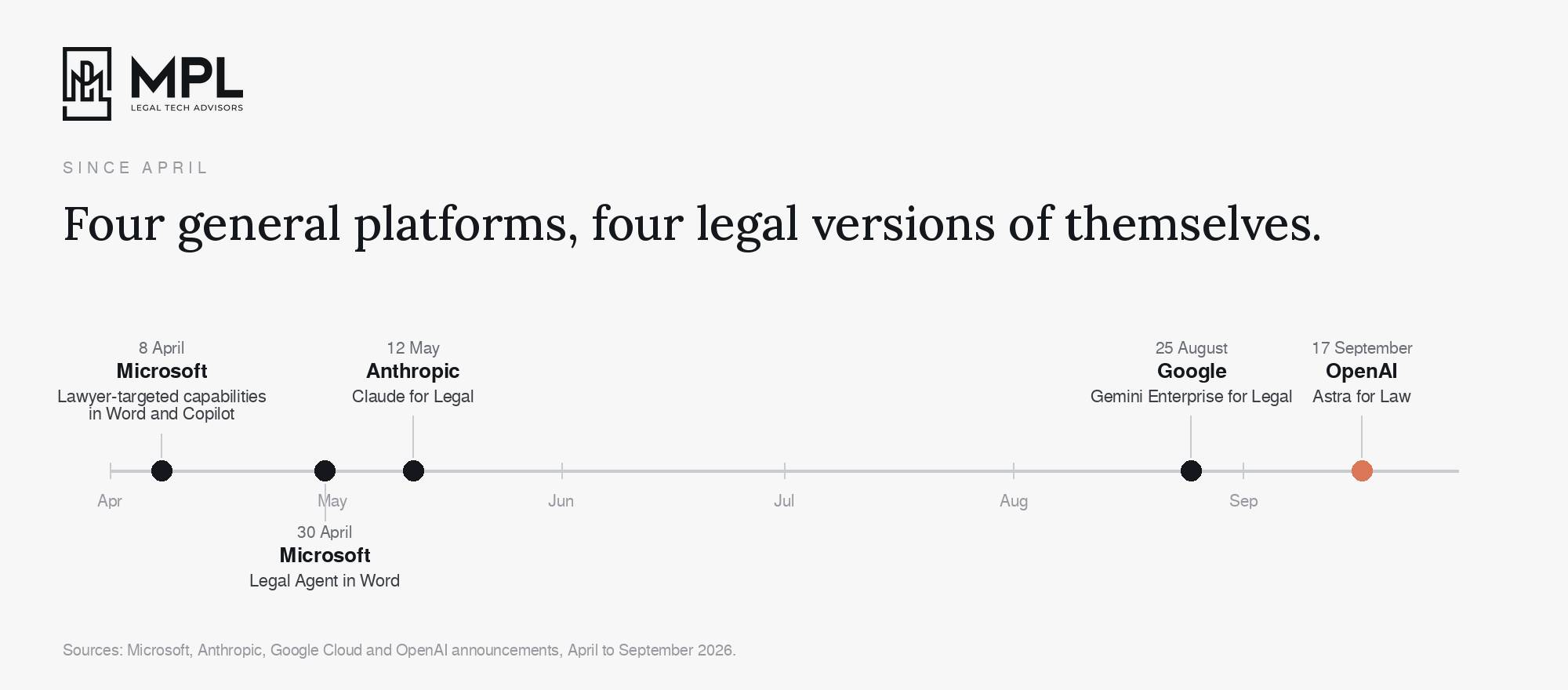
Four general platforms, four legal versions of themselves, all coming out in about five months. Plenty of people, me included, have been saying since the winter that this was coming, and each of the four is going to keep getting better at legal work from here. Every firm will have them within reach. Access that everyone has can’t be the thing that puts your firm in front and keeps it there.
Two Gaps
If you look at what each of these four can actually do today, they are getting very close to each other. Astra for Law comes with a research index OpenAI built partly with the Free Law Project, Gemini connects to iManage, NetDocuments and Everlaw, Microsoft added six legal connectors to Copilot on 2 September, and Claude has had these things since May, including connection to CourtListener. So whichever one your firm is on, it can read your documents, run a search in your research tool and knows what a lease is.
At the same time, I see a different gap widening. The firm has a capable platform, three or four people are using it really well, and everyone else is still opening a blank chat and typing the question from scratch, the same way they did in March. Or not even that. And at the same time, the knowledge the firm has gathered over the years still stays mostly in people’s heads. So that gap between the platforms doesn’t mean anything when you look at the gap between what the platforms can do and what firms make of them.
So how do you close that one? All week I kept ending up at the same thought. Every successful person I’ve ever listened to, whatever industry they were in, credits one thing above everything else, and it’s focus. And in a law firm trying to get somewhere with AI, I think focus looks a lot like investing, so I’m going to borrow five ideas from there.
Five Ideas Borrowed From Investing
Time in the market beats timing the market. Half a year spent going deep on the platform you already pay for leaves you with half a year of your own work written down: how you review a lease, what you always push back on in a settlement demand, which questions intake asks before a file opens. That written-down work compounds. Half a year spent waiting for the right platform to arrive or switching between them every few months leaves you with nothing to carry forward.
The gap is never the product. Morningstar measures it every year and finds that the average investor earns less than the fund they hold, purely because of when they buy and sell - in the 2026 study, 8.7% a year against 9.9% for the funds themselves over ten years. Your firm is holding a platform that can do more than the firm gets out of it, and the months after the rollout, when the novelty wears off and the habits either hold or don’t, are where that return gets made back.
Allocation beats platform picking. Firm knowledge cleaned up, processes written down, people trained. Those three account for the results I see, and none of them depends on which platform the firm picked. A firm that did all three on Copilot is ahead of a firm that did none of them on Astra, and it isn’t close.
A launch is a hot tip. Your skills library is a position. One feels like progress, and the other one is progress. The records-request skill your paralegal wrote in June belongs to your firm, and it keeps working every week, on every platform, long after anyone remembers which Thursday the announcement came out.
Pay off the debt before you invest in the next thing. Naming conventions, folder structure, the files nobody should be working from cleared out of the way. If you skip this, every new platform will hit the same ceiling.
The next launch is coming, and from what we saw in the past, I’m sure it’s going to be a good one. However good it is, the more of your own work you have written down by the time it arrives, the better it’s going to go for your firm.
Which AI Can You Use Today
The headlines make the four sound like a level field. A firm of 5, 10 or 20 people is looking at four very different situations, and the differences decide what you can do on Monday.
Microsoft’s legal work in Word comes in two layers. The April capabilities - track changes turned on from Copilot, comments anchored to the right text, tables of contents from your own headings - went out through the Frontier program on the Office Insiders beta channel. The Legal Agent itself, which reads a contract against your playbook and hands back tracked changes, still sits behind Frontier for US tenants with a Microsoft 365 Copilot licence, and general availability has moved to early October. What a small firm on Microsoft 365 can switch on today is Copilot itself plus the six legal connectors added on 2 September, with Descrybe already on in your tenant unless your admin turned it off. If your admin enrolls the tenant in Frontier, the Legal Agent comes with it.
Claude for Legal is the one you can buy on a Tuesday afternoon without speaking to anyone. The twelve practice-area plugins and twenty-plus connectors are open source and available on every paid plan, and a Team plan starts at two members, $20 a seat a month billed annually, $100 for a premium seat, with role-based permissions and spend controls in the admin panel. The connectors reach iManage, NetDocuments, Box, Everlaw, Relativity, Thomson Reuters and the Free Law Project (and much more).
Gemini Enterprise for Legal is still marked “in preview” four weeks after launch, and the only route in is a contact-sales button. It ships as a plugin inside Gemini Enterprise rather than as a product of its own, the named customers are Cleary, Freshfields, Weil and Williams & Connolly, and Google has published no pricing and no seat floor. A small firm on Google Workspace has Gemini in Docs and Gmail today, and that is where it stays for now.
Astra for Law is not available to you. It is offered to selected firms through Trusted Access aimed at the Am Law 200 - Sullivan & Cromwell, Ropes & Gray, Cooley, Skadden, Wachtell and Latham are the names on the announcement - and the API is “coming soon”, which is how it will reach you eventually through Harvey, Legora or whichever vendor builds on it. A firm on ChatGPT Business has the same ChatGPT it had two weeks ago, and the research index that makes Astra interesting is not part of it.
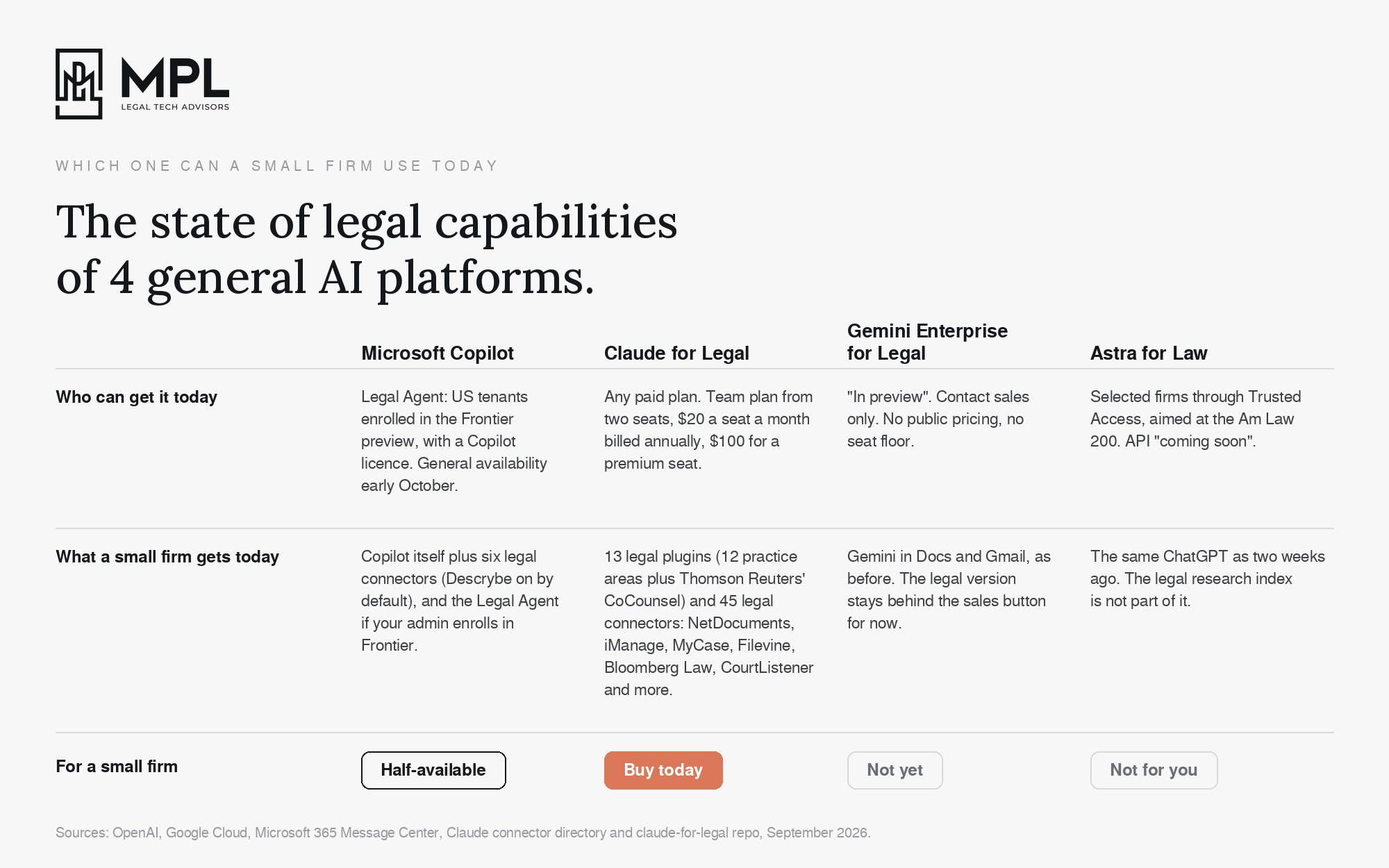
So one of the four is buyable by a small firm this week, one is half-available depending on what your admin enrolled in, and two are for firms with a sales rep. If you are on Claude, keep going. If you are on Microsoft, the Legal Agent is a month away and Copilot with the connectors is here. If you are on Google or OpenAI, the work in front of you is the same work it was last week, and the writing-down part of it does not need any of the four.

On 16 September Anthropic started rolling out, in beta, one Claude instead of two. The idea behind is that you shouldn’t have to figure out whether you need Chat or Cowork, Claude should do that for you.
Two more things came out the same day: Claude Docs and Claude Slides. The idea behind those is that once Claude writes something for you, you shouldn’t have to take it into Word to finish it. You and your team edit it right there in Claude, and export it when you’re done.
Anthropic says it’s on for Pro, Max and Team, and Enterprise admins can turn it on under Organization settings > Artifacts. I still don’t see any of it, not on my personal account and not on our Team one, so don’t worry if you don’t either. It’s coming.
On 22 September Anthropic also released Claude Opus 5.5. It does most work at the level of Fable 5.1 and Anthropic says it costs 40% less to run than Opus 5. Two things are important for a law firm. The writing is clearer: it puts the important part first and follows the writing rules you give it, which was the most common complaint about Opus 5. And the usage limits on Pro, Max, Team and Enterprise went up at the same time, so the same seat now gets more work done before it stops you. Sonnet 5.5 and Haiku 5.5 follow in the coming weeks.
Legal AI in Action
🎬 Claude + Clio: Why You Need Both a Connector and a Skill
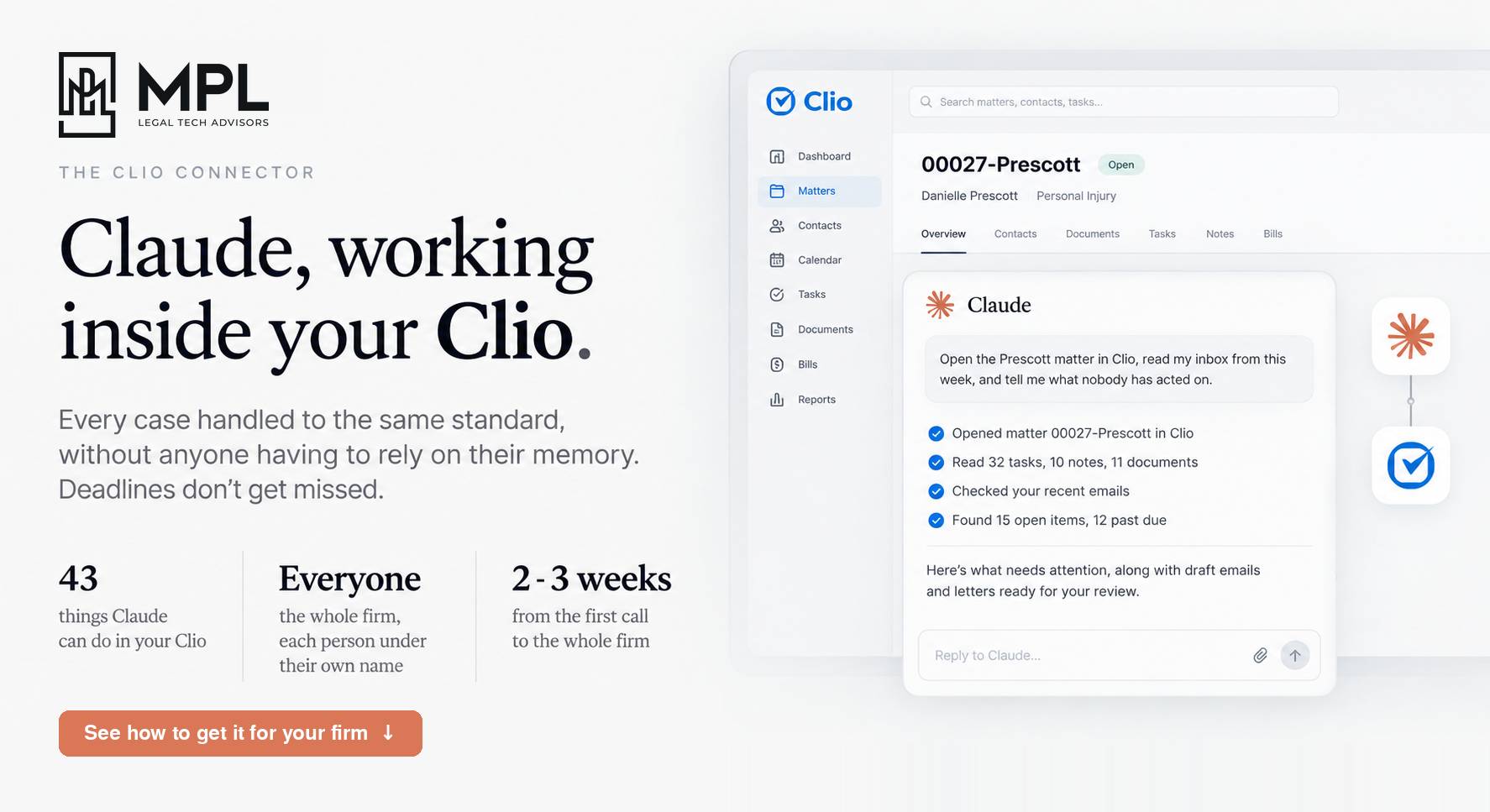
In the 3rd video in our Claude + Clio series, I take the connector we built at MPL Advisors one step further. A connector lets Claude work in Clio, but it still does not know how your firm actually works. I show that with a new client intake, first running it from a long prompt and then turning the process into a reusable Skill, so Claude can follow the same steps every time without somebody having to explain them again.
Want Claude working inside your Clio?
At MPL Advisors, we built the Clio MCP Connector we use in the videos above. We set it up inside your firm’s Microsoft tenant, work directly with your MSP, and can then turn one of your firm’s repeatable processes into a Skill with your team.
🎙 It Looks Good Until You Know Enough About Law
Lauren E. Diaz teaches law in San Francisco and in Florida, runs a law library, coaches bar exam candidates and is the technology and innovation fellow at Nova Southeastern. Her focus is preparing the new generation on how to work with AI without losing the judgment underneath the work. A lot of our conversation came back to the same point: before you automate anything, you need to know what problem you are actually trying to solve.
We talked about why AI can scale a bad process just as quickly as a good one, why one vendor session does not mean your lawyers are trained, and why junior lawyers still need the struggle that builds judgment. Lauren also made the case that AI is exposing an older problem in law firms: too many never had a real system for developing their people in the first place.
Coming up!
🎙 Next Tuesday at 2pm CET!
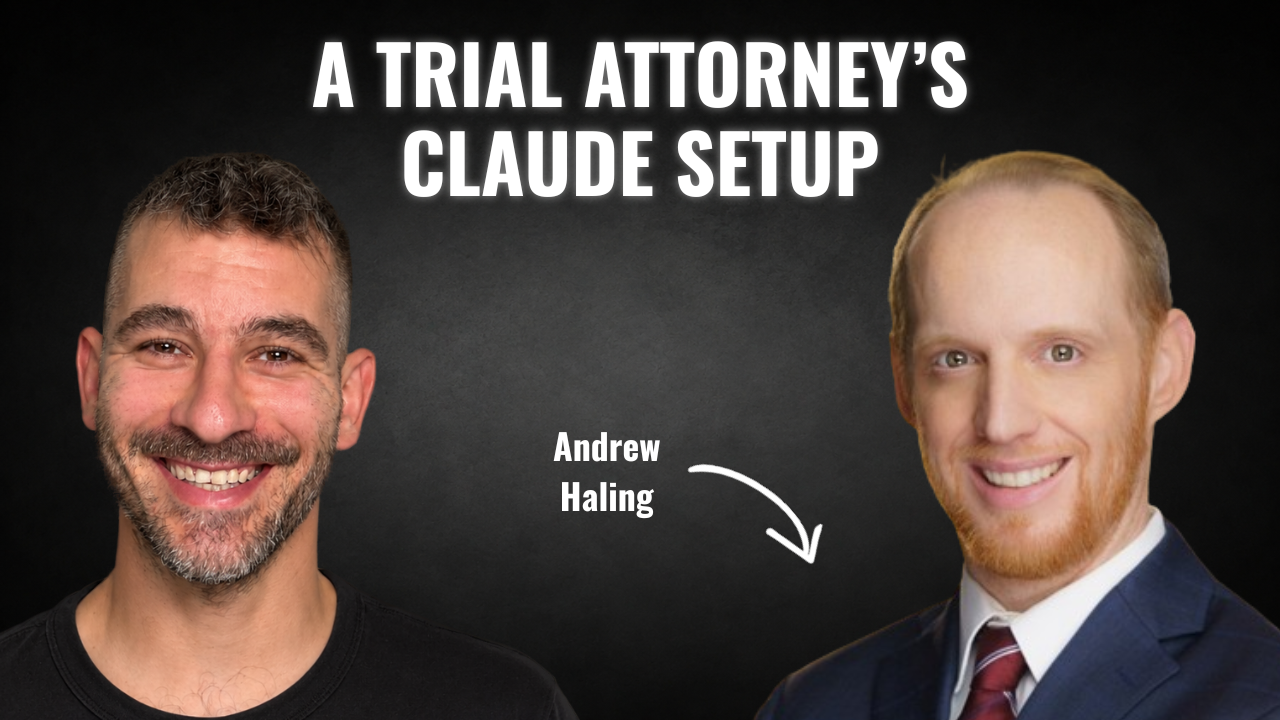
Next week’s guests on Rok’s Legal AI Conversations is Andrew Haling, a trial attorney at Pathway Law Firm in Beverly Hills, handling personal injury, wrongful death and catastrophic injury cases across California, Arizona, Texas and Colorado. His firm runs Claude Enterprise, and he’s the one who built what they use on it.
He tells me why he doesn’t want a product built for everybody, because a jury can tell when you’re trying to be someone you’re not, and the same goes for what your AI writes; why only a few people at the firm get full access while the junior attorneys keep doing the work by hand first; and how he uses Claude with the 5,000 pages of medical records so he only has to read the 75 that matter. We also get into the thousands of dollars a month in tokens, and the issues page he makes every skill produce at the end, so the contradictions in the record land on his desk instead of getting quietly resolved.
Each edition of Legal AI Brief brings practical lessons from firms using AI safely.