
Couldn’t Bring Themselves To Hire
This edition was largely inspired by the work we did recently with 11-person boutique in the US and I wanted to write about it because the position they were in when we started is where a lot of firms are right now.
The first time I talked to the managing partner he told me they have been wanting to hire an executive assistant for about a year. He hadn’t pulled the trigger, and it wasn’t at all a budget question. Business has been pretty good and they’ve been growing every quarter. But every time he sat down to write what the assistant would actually do, he kept on realizing that too much of how he qualified leads, ran consults, and got engagement letters out the door lived in his head. He didn’t have the bandwidth to teach it. And even if he did, he had no way to check whether the next assistant was doing it the way he’d taught them.
If I could only be a fly on the wall when you’re reading this to see how many of you had recognized yourselves in this.
Because from what I’ve seen across my work with boutiques that’s the case for most partners running a relationship-led practice. The pipeline is personal because the work is personal and the whole flow from inquiry to engaged client tends to ride on the partner himself.
Now that particular partner had been told he should be looking at AI. What he wasn’t sure about was where to start.
The Boutique AI Climb Pointed At…
Luckily we’ve done this more than a few times, so we have a way to start looking at what we have in front of us, and we usually do that through the lens of the Boutique AI Climb. When we did that, intake came up as the right area to work on, but for a different reason than the sheer volume.
Usually when intake comes up as the bottleneck, it’s because of the volume that’s coming in. Too many leads, time per lead growing as the firm grows, structured data not flowing through. That wasn’t the case here. The volume was modest. BUT, the reason intake still needed attention first was that the work required the partner’s brain, for the full thing. It sat entirely with him and couldn’t be delegated, because nothing about it had ever been articulated outside his head.
So the first move was to lift the work out of the partner’s head into a form an assistant, being it human or AI, could ever actually run.
When The Bottleneck Sits In One Head
The usual intake optimization questions don’t get you far here. Adding an automation layer doesn’t help if there’s no decision logic to apply.
I recently had a conversation with Horatiu Druma-Strugariu, a former litigator, now a principle legal AI engineer. Horatiu pointed out that we as humans have a tendency to bundle skills together that don’t strictly need to be bundled, because of how we historically had to do the work. His worked example was knowledge management. Is the point of KM the skill of organising knowledge, or is it to encode and pass that knowledge on? Most of us assume we need the first to get the second, while the existence of KM specialists and law librarians says we don’t.
If I use this logic, the partner here is the bottleneck because the firm has never separated the parts of the work that need their judgment from the parts that don’t. But how do we start pulling those apart?
Some questions you might find useful for that purpose:
- What’s the outcome this work exists to produce?
- Can that outcome be produced without the lawyer holding the skill?
- Who else could hold it - a specialist, AI, both?
- What does the lawyer’s professional development look like if this skill goes elsewhere?
What does the payoff look like?
Once we had run through the four questions on each phase, the solution that came out of it fit inside what the 11-person boutique already had. Microsoft for the parts that run on their own, Claude for the parts where the partner is the trigger. And in this case, like in a lot of others, there was no need for any new vendors.
The qualification work which was essentially assembling information from multiple sources now lands as a structured brief in their DMS a minute or two after the lead comes in. The partner reads it and makes the call to pursue or decline it. After the consult, he voice-notes a quick recap and the relevant pieces get captured and filed in the same structure every time. By the time he sits down to write the engagement letter, the draft is already there for him to review and send.
The decisions only the partner can make still sit with him - pursue or decline, the consult itself, the final review on every engagement letter. The personal email, the call from his cell, the calendar invite, the look and feel of every artifact a client sees - all of it stays as it was. From the client’s side, nothing has changed.
And so the loop he came in with quietly closed. The work that used to live entirely in his head now lives in plain language files on his stack - built as a side effect of doing this work. The next executive assistant he hires can read those files on day one. The two-month shadow period he was dreading is now off the table.
Legal AI in Action
🗣️ Quoted alongside Mark Pike in Law 360
Law360 Pulse covered how Claude for Legal and Will Chen’s MikeOSS are opening legal AI up to small and midsize firms. I shared my read on why this moment is the chance for boutiques to punch above their weight with tools that are already accessible.
🎬 Claude For Legal 2.0: Don’t Use It Out Of The Box
What skills, connectors, and plugins actually are with examples of each, how to download and install new Claude legal plugins, how to run the cold-start so it knows your firm, and the three Microsoft pieces you already have that close the Cowork compliance gap.
🎙 Three pillars of AI readiness
Melina Efstathiou is a strategic advisor on AI governance and legal tech, guest lecturer at King’s College London, and ACEDS Global Ambassador. Originally a criminal-fraud solicitor, she spent five years as Head of Litigation Technology at Eversheds Sutherland before stepping into independent advisory work. We talked through her three pillars of AI readiness - infrastructure, internal data, and the human side, where a partner should start when the noise feels overwhelming, and her RAC framework (Responsibility, Accountability, Control) for the accountability gap that a lot of times lacks a named owner.
Coming up!
🎙 Next Tuesday at 2pm CET!
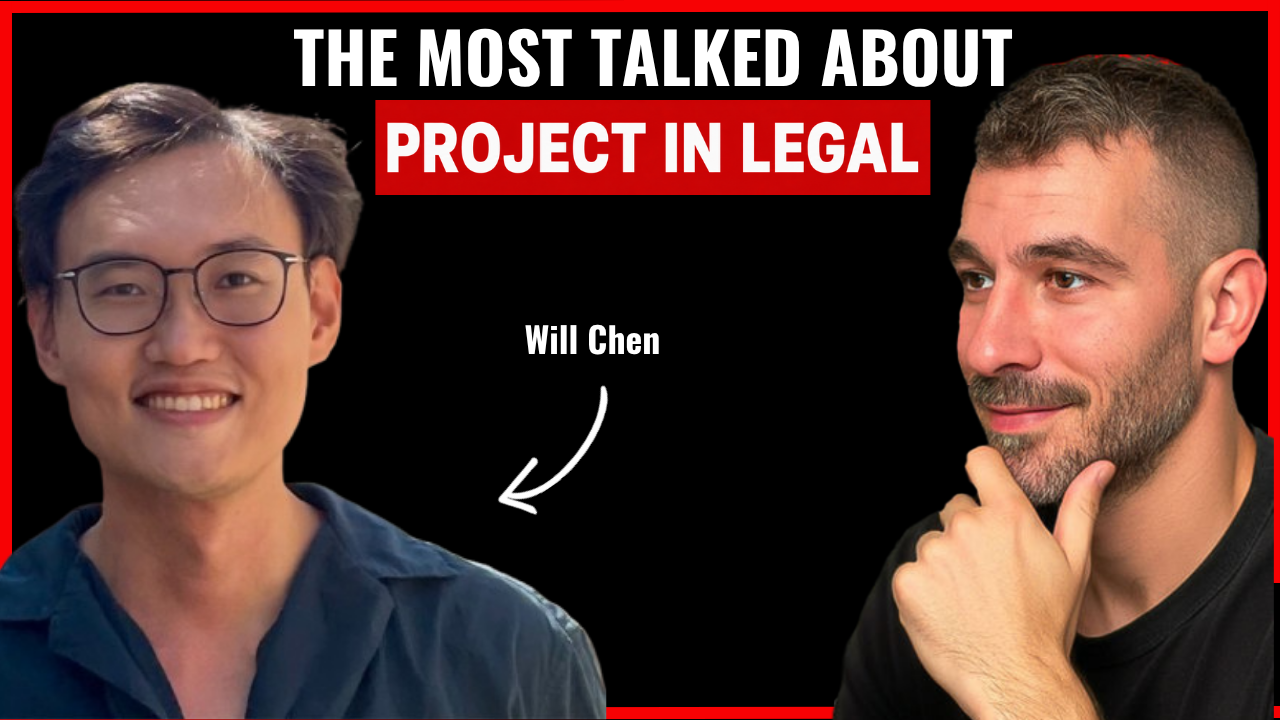
Next week’s guest on Rok’s Legal AI Conversations is Will Chen, former Latham & Watkins lawyer and creator of MikeOSS, the fastest growing open-source legal AI project that hit more than 3k GitHub stars within weeks of release. He built it in two weeks, deliberately, to make a point about what a lot of vendors actually are today.
We discuss how MikeOSS is positioned on the market, why open source becomes attractive what you think about vendor lock-in, and the strategic risk most firms aren’t yet pricing in with big legal AI tools.
Each edition of Legal AI Brief brings practical lessons from firms using AI safely.