
Anthropic’s Big Bang
Just days after Harvey announced its long-horizon agents and Legora launched its agentic operating system, Anthropic came out with a big bang of its own. 12 legal plugins tailored to specific practice areas, 20+ MCP connectors plugging Claude into the tools lawyers already work in.
Almost at the same time, both Harvey’s and Legora’s CEOs put out nearly identical LinkedIn posts welcoming the move, telling everyone how this is just a confirmation that they were right to move into legal in the first place.
I wonder how long that story is going to hold. From where I’m standing, we now have three big legal AI providers on the market, and only one of them is built for the kind of firm a boutique partner runs.
A Different Move
Anthropic also ran a second Claude for Legal webinar last week. It almost felt like they were trying to set the record straight from the first one. Now this one left a lot of people with a feeling that Anthropic is going to keep moving into the same layer Harvey and Legora are in.
Helen Fan made a related point and put Anthropic’s move at Level 4 on her Legal AI Value Stack. She lists them as organizational infrastructure that sits across HR, sales, ops, and now legal. Once a firm is running Claude across those functions, no vertical legal AI player can really match Anthropic on the reach, however good their own legal stack is.
A few of the more skeptical reads pointed at the fact that the new plugins are designed to be customized per firm and per lawyer, and that customization means work. Without it, you end up with generic platform doing generic work. Which is definitely true and something Mark Pike pointed out during the webinar.
He also pointed at the bigger move - Claude is going inside the tools you already use, wired into Word, Outlook, Excel and PowerPoint with the matter context carrying across all four. Squeezing what the firm already pays for, in Boutique AI Climb terms.
So, Harvey, Legora and now Anthropic. And only one of those meets boutiques where they are.
The Connectors
One of the more interesting pieces of Claude for Legal is the connector layer. The connectors wire Claude into the rest of the firm’s stack, such as iManage or NetDocuments on the document side, DocuSign on signing, Westlaw on the research side, whatever the firm already runs on. I call this Stitching in Boutique AI Climb terms, and at boutique size it’s one of the most powerful moves a partner can make, because of how much capability comes out for how little new money in.
After Anthropic’s last webinar, I’m starting to get a lot of questions around whether firms can use the connectors out of the box and whether their existing contracts cover them when they do.
Two Connectors, Two Truths
Take two of the connectors on the table. The M365 connector is the clean case. Anthropic runs the server, your data stays in your Microsoft 365 tenant, every action is logged in the firm’s existing M365 audit log. Anthropic published a full security guide on it. Your Anthropic plan covers what Claude does with the data, your existing Microsoft terms cover the rest. This is the one Anthropic hosts directly.
DocuSign is the other case. The connector is listed in Anthropic’s directory, but it’s hosted by Docusign and currently, in closed beta. Production access is gated by an application form. The beta terms layer on top of whatever your firm already has with DocuSign. Listed in the marketplace doesn’t mean ready for client work.
The DocuSign pattern, not the M365 one, is the norm. Most MCPs are vendor-built, vendor-hosted, and governed by the vendor’s terms. Your Anthropic plan covers what Claude does with the data, but it doesn’t cover what happens on the vendor’s side. So when you wonder whether your firm can turn one on, the first question is who hosts the server, and the second is what contract covers that side.
What’s on the Other Side
I’ll admit, vetting is some work, and when you get through it on the connectors that fit, what your end up with is Claude wired into the tools your lawyers already use, doing the work on their actual matters, using the firm’s documents, the firm’s playbook, the firm’s voice.
That’s what a firm experiences once the Stitch is wired in. And the vetting itself stays roughly the same shape every time. Same questions, just different answers depending on the connector.
I put together six questions to answer when evaluating MCP connectors for your Claude, plus reviews of the six most common connectors in law firms today.
You can get yours free here.
Legal AI in Action
🗣️ Are The Robots Really Ready?
I joined David Curtain on Front Foot’s CPD webinar. We talked about where AI is actually delivering for legal teams today, how teams of any size can get started with what they already have, and how to keep humans in control.
Watch it here for free.
🎬 The Fractional Boutique AI Partner
The four pressures putting this role on partners’ desks, what it actually does at a firm; from vetting connectors to writing the firm’s own skills, setting up workflows and bringing the team along, and why the fractional shape is what fits boutique size.
🎙 Eight Years In Legal Tech. What Changed?
Horace Wu is the founder and CEO of Syntheia, a knowledge platform for lawyers. He practiced at Shearman & Sterling, DLA Piper, and King & Wood Mallesons before going in-house, then jumped into legal tech full-time in 2018. We talked through the procurement principles that haven’t actually changed despite the market noise, his four-persona framework for matching the right tool to the right user inside a firm, and the training problem creeping up under all of this: how can juniors get good when AI is doing the drafting.
Coming up!
🎙 Next Tuesday at 2pm CET!
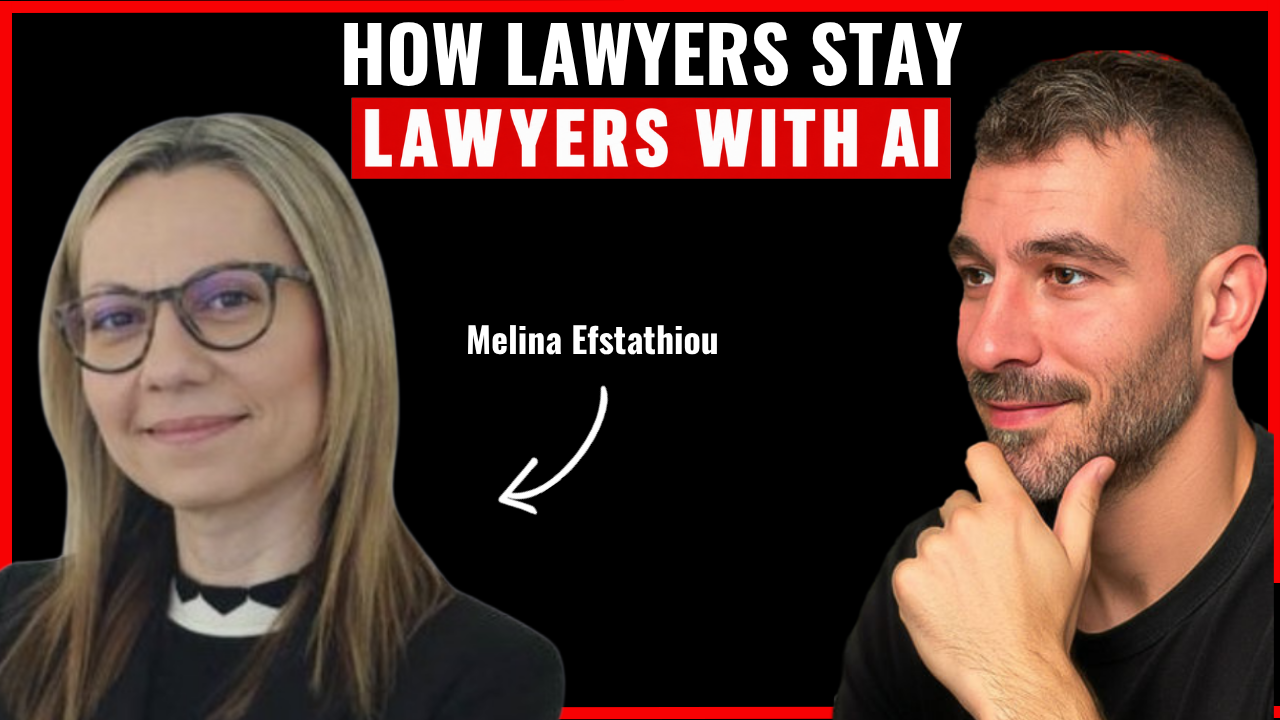
Next week’s guest on Rok’s Legal AI Conversations is Melina Efstathiou, strategic advisor on AI governance and legal tech, guest lecturer at King’s College London, and ACEDS Global Ambassador. Originally a criminal-fraud solicitor, she spent the last five years as Head of Litigation Technology at Eversheds Sutherland before stepping into independent advisory work.
We talk about her three pillars of AI readiness - infrastructure, internal knowledge, and the human side, where a partner should actually start when the noise feels overwhelming, and her RAC framework (Responsibility, Accountability, Control) for closing the gap that doesn’t yet have a named owner.
Each edition of Legal AI Brief brings practical lessons from firms using AI safely.