
The $500M Number
Kirkland & Ellis announced this week that they’re spending $500 million over the next three to four years to build their own proprietary AI platform. $100 million of that gets deployed in 2026 alone, roughly 1% of the firm’s annual revenue going into a single technology bet.
Around 250 of their lawyers, including 100 partners, are working alongside 180 technology professionals to map the firm’s real workflows into the platform. Kirkland is building it themselves rather than licensing it. The whole thing is being walled off so vendors can’t resell it elsewhere.
Everywhere you look this past week, you’ll find a quote of this line from Kirkland’s leadership: “Widely available AI tools are raising the floor for everyone, but we don’t get hired for the floor”. That’s the world’s highest-grossing law firm saying publicly that getting hired over the next few years depends on having something off the shelf AI alone cannot give you.
Why $500M
What Kirkland is paying for is a wall. Behind the wall sits what every law firm’s real asset has always been: how their partners structure a deal, where they push on a term, what they’ve seen go wrong a hundred times. Until now, that asset has lived in partners’ heads. A proprietary AI platform pulls all of it into one place that compounds, and once you own that, you own something no vendor can sell to your competitor.
And more than a wall, what they are encoding into that platform is their operational and institutional moat. The wall really is necessary at this scale to stay defensible on the market for the time to come. Even when the big AI providers commit not to train their models on a firm’s data, the volume and shape of what passes through their platforms still leaks signal about how the firm operates, signal that could in principle be used to infer the firm’s most sensitively guarded IP. A walled platform keeps that risk off the table entirely. The $500M is what the moat and the wall around it together cost to build at Kirkland’s scale, with Kirkland’s economics, on Kirkland’s timeline.
The question for the rest of us, and especially for boutiques, is whether the moat itself is only available at that price.
The Boutique Version
And the answer is, it isn’t. The Boutique AI Climb has been heading here all along. What we now call Arc 1, the operational layer with intake, matter management, and billing wired into workflows and the data substrate accruing underneath, was the foundation. The moat sitting behind Kirkland’s $500M is what comes next.
The Boutique AI Climb has been heading here all along. What we now call Arc 1, the operational layer with intake, matter management, and billing wired into workflows and the data substrate accruing underneath, was the first half of the picture. The moat sitting behind Kirkland’s $500M is what Arc 1 has been pointing at the whole time.
Arc 2 is the moat itself, that same asset behind the wall, encoded onto what Arc 1 built. The encoding runs as a build ladder, starting with the voice the firm writes in (already extractable from past drafts), then the decision criteria the partners apply, then the patterns and templates, then the client specific context, and finally the matter by matter narratives that take a small amount of active partner input. The substrate captures all of it as the firm works. The agents reading from the substrate produce work in the firm’s voice, against the firm’s criteria, to the firm’s standards. The lawyer’s judgment is the gate, with adversarial review and second-pass reasoning baked into the flow before anything reaches the lawyer’s desk.
On the security side, the inference risk Kirkland is buying out of doesn’t show up the same way at boutique scale. Volume is much smaller, and what passes through a vendor’s platform from a boutique carries a much weaker signal for anyone trying to infer how the firm operates. Kirkland is protecting the kind of matters where every term has billions in implications and the specific structuring approach could be worth a fortune to a competitor, and a boutique typically doesn’t operate at that tier. The standard vendor protections, no-model-training commitments, encryption, signed DPAs, are calibrated for boutique scale and cover the risk that’s actually there.
That’s the boutique version of what Kirkland is paying $500M to build. The end state is the same. The mechanism, the cost, and the time horizon are all different. The version that fits a boutique law firm, without venture money and without an internal engineering team.
What Kirkland Changed
For boutiques, deferring the decision was a reasonable position as recently as last month. The largest firm in the world hadn’t put a number on the moat yet. The vendor landscape was still in motion, the frameworks for thinking about this weren’t sharp, and a managing partner could defensibly say the decision wasn’t ripe. Kirkland’s $500M ended that.
Firms now have to decide where they sit between Kirkland’s full build and a tool subscription, and decide actively rather than by default. There are three positions to choose between. Build the whole thing in-house, which is what Kirkland is doing. Subscribe to whatever vendor is loudest that quarter, which has been the default position for years. Or assemble what the firm already pays for, stitch it together, and encode the firm’s craft on top of the resulting substrate as the work flows through.
The $500M is also only the build cost. Whatever Kirkland builds, the maintenance is forever, because the field moves every quarter, the tools improve, the lawyers’ expectations shift, and a platform that doesn’t move with all of that stops getting used. The assemble route runs on the same dynamic at a much lower scale. The vendors handle most of the maintenance, and the firm’s job is to keep stitching as the components evolve and to keep feeding the substrate the firm’s own work.
Legal AI in Action
📰 Boutique AI Climb: The Institutional Moat
How the climb splits into Arc 1 (operational) and Arc 2 (the institutional moat), the five categories of institutional knowledge with a build ladder, the Stack judgment that keeps the climb from being over-engineered, and the compounding boutique at the end of both arcs.

🎬 The Boutique Answer to Kirkland’s $500M AI Spend
What Kirkland & Ellis is buying with $500M and why the underlying logic holds, what Steven Sinofsky gets right about the legacy risk, and the boutique answer at a fraction of the cost: the two arcs of the Climb, the four refinements to Arc 1, and the five categories of the institutional vault.
🎙 The open source bet on legal AI
Will Chen is the creator of MikeOSS, the fastest growing open source legal AI project on GitHub. After three years at Latham & Watkins, he left during the AI wave and built MikeOSS as proof the leading legal AI products are simpler under the hood than their valuations suggest. We talked through the case for open source in legal AI, the strategic risk of giving incumbents deep visibility into firm workflows they may eventually productize, and the Schrödinger’s legal AI problem of vendors telling clients they don’t train on the data while telling investors the data is the moat.
Coming up!
🎙 Next Tuesday at 2pm CET!
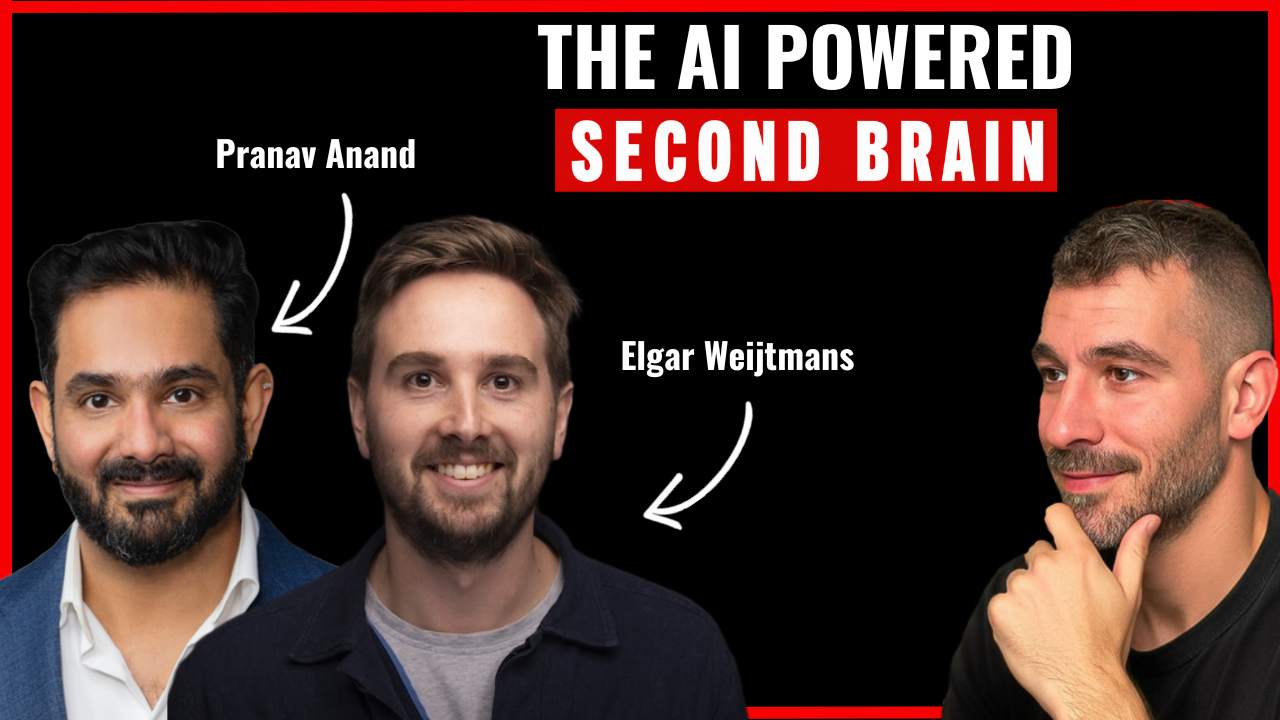
Next week’s guests on Rok’s Legal AI Conversations are Pranav Anand, Head of EMEA Digital Forensics and E-Discovery at Gravity Stack, and Elgar Weijtmans, Head of Technology at HVG Law and CTO at LegalBenchmarks. While legal still debates whether agentic AI is ready, these two are running autonomous agents at home on local models, parsing 10k PII documents offline in three days at work, and threatening their LLMs with drive format when they won’t behave.
We discuss what an agent actually is under the hood, where agentic AI breaks for legal work and where it earns its keep today, and the home lab approach as the way to experiment safely before any enterprise deployment.
Each edition of Legal AI Brief brings practical lessons from firms using AI safely.